ura, 2023
installation (scroll down for more info)


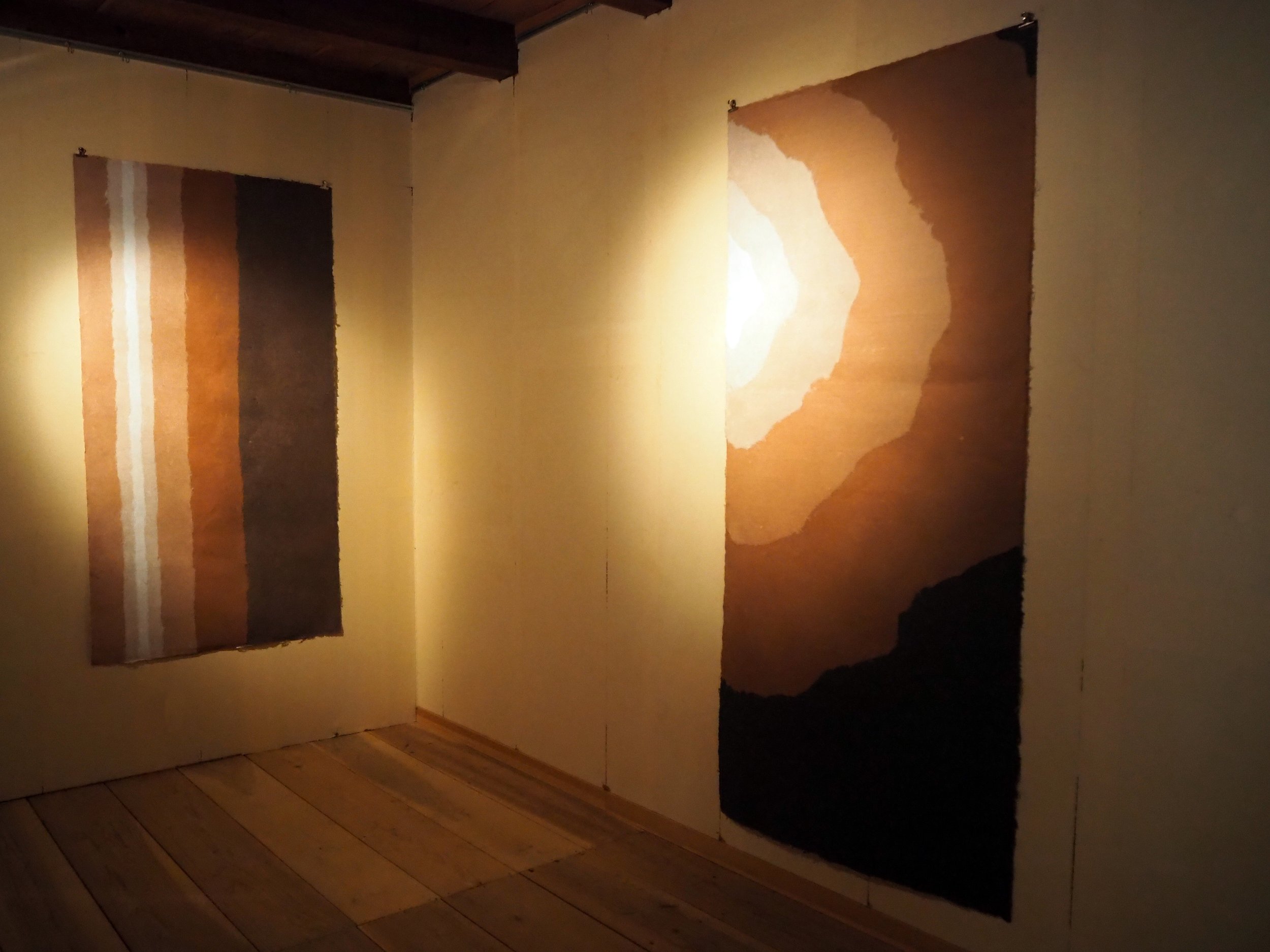


Paper handmade by the artist (kozo)
The title Ura references the underside of handmade paper — the side that touches the drying surface, such as a board or a hot plate. The word is used in artisan circles to describe the “smooth” side of the paper. Yet the word in Japanese can also refer to the concept of one’s “private self,” or the reality of a situation behind the glossy covering. In this work, the ura is these pulp paintings: the works themselves made backwards, with the artist never seeing the result until they are peeled off the screen. They reveal basic gradients, portals, and light lines, and a restraint that contradicts the textured, painterly omote (front side, or “image” of something).
This installation was shown at the current Mi-Lab Mokuhanga Innovation Residency, formerly the Yamatoya Gallery (Japan). Historically, the structure was a kura, or Japanese storehouse. The installations omote and hikari are related artworks and were shown within the same structure. These works were made with the site in mind. Each Ura pulp painting is the size of a fusuma sliding door. Fusuma are traditionally swapped depending on the season, and in the past were made with decorative sheets of handmade paper that evoked the season (e.g., cherry blossoms or pine trees). By mimicking the dimensional ratio of fusuma, the pulp paintings of this installation reference spatial and conceptual transition.